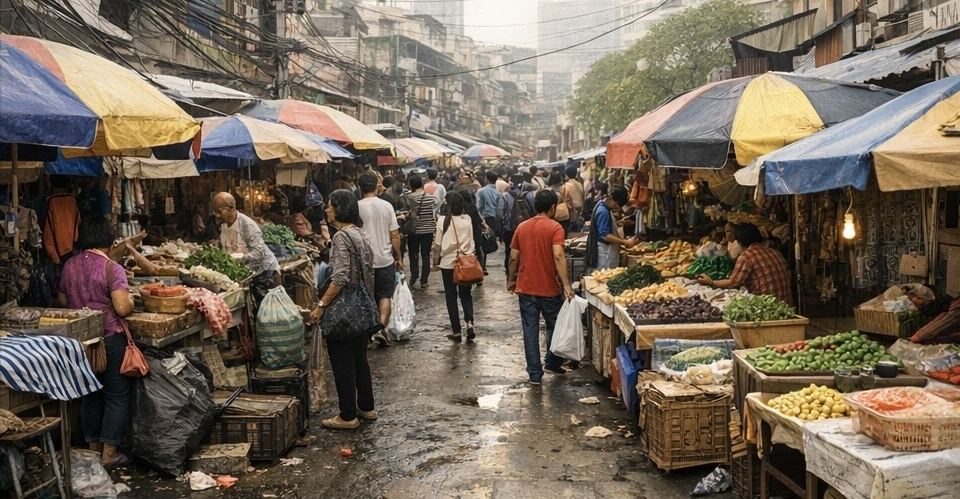
Among the reels asking "why is India so dirty?", there is another kind that is quietly growing: young people pulling plastic out of rivers with their bare hands, friends spending Sunday mornings on a lake shore, a single person who decided one stretch of land was going to change. They are not waiting for permission, a budget or a government scheme.
They are also not new. India has a long line of people who decided that the shared space outside their door was their responsibility. Here are three whose work has lasted — and the lesson each one leaves for the rest of us.
Afroz Shah
A young lawyer looked at the beach outside his flat, buried knee-deep in plastic, and started picking it up with a neighbour. Every weekend. Others joined: fishermen, slum residents, schoolchildren, film actors. The UN Environment Programme called it the largest beach clean-up in history — over 85 weeks, volunteers removed about 5.3 million kilograms of waste from the 2.5 km shore.
The lesson: show up every week. Consistency did what no one-day drive could.
Anand Malligavad · "the Lake Man"
A mechanical engineer who started giving his evenings to a dying 36-acre lake, Kyalasanahalli, near his office. He brought residents together, convinced his company to fund the work, and used old Indian methods of tank-building to bring the water back. He has since been reported to have revived dozens of lakes in Bengaluru, and more in Ayodhya, Lucknow and Odisha.
The lesson: bring the community and a company (CSR) to the same table. The people give ownership, the company gives fuel.
The Ugly Indian
An anonymous, leaderless group with a blunt motto — "Kaam chalu, mooh bandh" (stop talking, start working). They do "spot-fixes": clean one ugly stretch, scrub the paan stains, fix the footpath, paint the wall. Their rule is the most important part: a spot-fix only counts if it is still clean after 90 days.
The lesson: the clean-up is not the finish line. If it doesn't last, it didn't work.
Cleaning a place is a moment. Keeping it beautiful is a decision.— MIB Stories
What all of them have in common
- Ownership. Each one treated a public place as "mine". Not the government's, not "someone's".
- A neighbourhood, not a hero. Every story started with one person, but succeeded because neighbours joined.
- Persistence. Weeks, months and years — never a single photo-op.
- A plan for after. The places that stayed changed were the ones where someone kept caring.
Where design comes in
Here is the gap MIB sees again and again. A beach or a lane gets cleaned, but nothing about the place changes: there is still no bin at the corner, no space for the vendor, no tree, no light, no reason for people to treat it differently. Slowly, the old picture returns.
Cleaning removes the problem. Design removes the reason for the problem. A planned waste point, an ordered vending line, a walkable footpath, a planter where the dump used to be, a wall with art instead of posters — these make the clean version of a place the natural version.
That is why every MIB project pairs designers with a care plan. The design makes it beautiful. The MIB Care Team, with the residents, keeps it that way.
You don't need to be famous to start
Afroz Shah started with one neighbour. The Ugly Indian started with one stretch of pavement. You can start with one street — your own.
With the MIB Street Pledge, you upload a photo of your street, invite your neighbours on WhatsApp, and when half the homes pledge, an MIB designer plans it with you. If you are already cleaning a lake, a beach or a lane, we would love to tell your story here — send it to us on WhatsApp.
Sources
- Largest beach clean in history lays waste to marine litter — UN Environment Programme
- 85 weeks and 5M kg of trash later, Versova Beach is now clean — YourStory
- India's Lake Man: Bengaluru-based mechanical engineer on a lake revival mission — Onmanorama
- The Ugly Indian — Wikipedia
Pictures on this page are illustrations and MIB design visions, not photographs of the places named.